Trauma
The first and primary treatment of a fracture decides the final outcome. The best center with good initial fracture fixation gives the best chance for the patient to recover fast and to come back to normal life without any disability..
Our success is because of the resuscitation of the patient in the “Golden Hour” and “0-hour” treatment of fixation of fracture and wound coverage. This concept has revolutionised fracture management and by the word of mouth, our patients spread this message about the reputation, treatment, and care given to them. This has dramatically reduced the morbidity, mortality, and expenditure, and in no time the patients become normal.
Patients with multiple fractures get the fracture fixed by a team of orthopedic surgeons in one sitting. For example patient with 12 bone fractures had fixation of all fractures within three hours. We give the best outcome with the least complications.
We are experts in treating ununited fractures, fractures not healed for many years, fractures with infection, and fractures healed in abnormal positioning (Mal union) resulting in deformity.
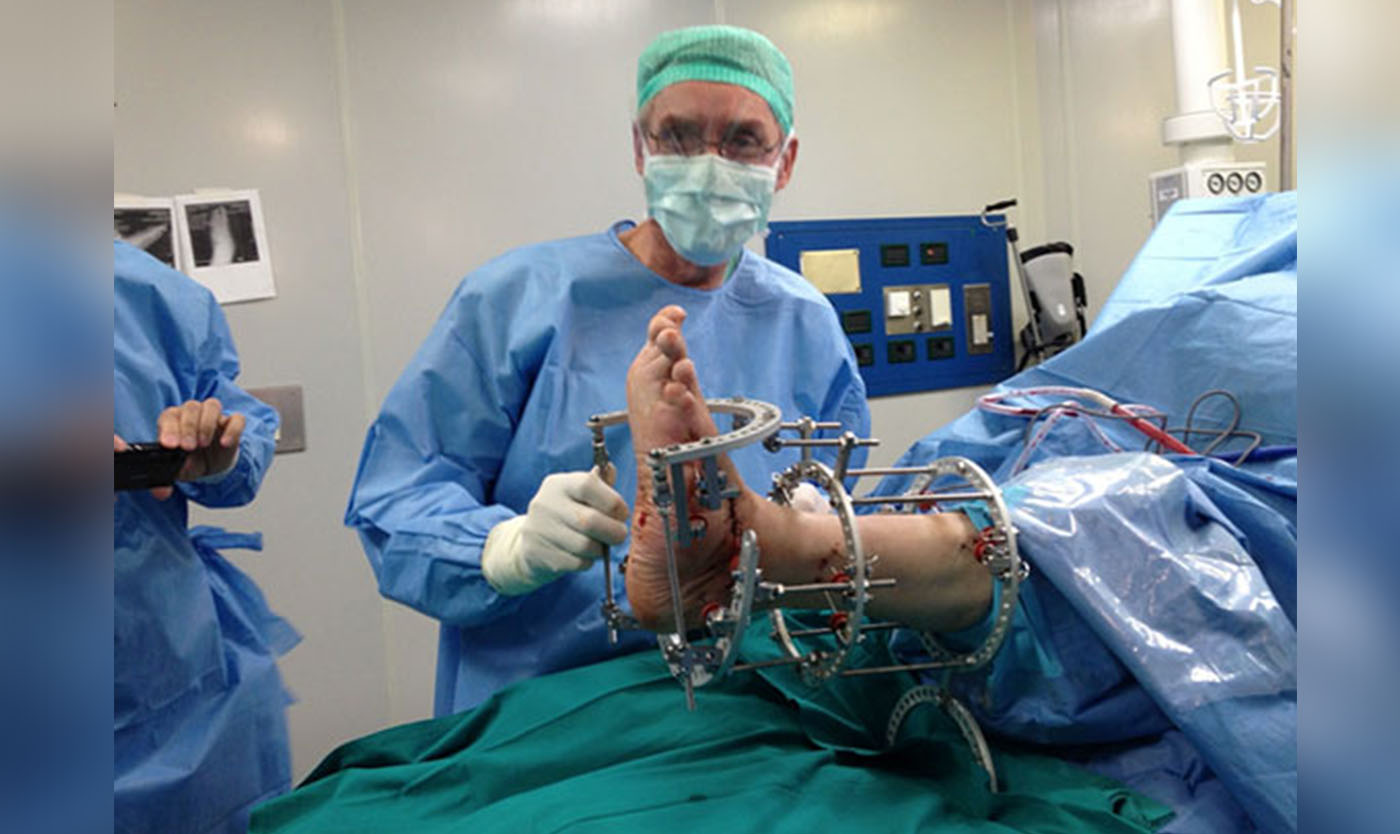
We use various limb reconstructions systems in extensive bone loss. We have grown more than 25cm length of the thigh bone, leg bone and saved many patients from amputation
Arthroscopy
This is a Key Hole Procedure done to visualize the joint and repair the torn ligaments. Most of the time it is a day case procedure. This new advancement has revolutionized surgery in the joints. This keyhole surgery is the ‘arthroscopy’ procedure. Dr.A.Prabhakaran says “Arthroscopy has made procedures a lot simpler, easier and precise for us doctors. What was previously a procedure based purely on years of experience has now been given an additional eye to make it even precise and work on the nook and corners of the inaccessible areas .”.
By attaching a camera to a fibre optic cable which helps project the image onto a miniature TV screen, the doctor skillfully guides the scope to the desired location and operates with minimum invasion. Unlike an open surgery which may require major cuts and incisions, arthroscopy requires only a minor cut. Hence the name ‘keyhole’ surgery. The cartilages, ligaments, tendons are visible to exactly determine the extent of injury and quickly perform the repair. Sometimes along with X rays additional tests such as MRI and CT scans will also be required.
Arthroscopic surgeries are done for the following acute/chronic nature
The applications of this surgery are many and this revolutionary technique has made the dreaded word operation a much safer and simpler alternative. More and more patients all over the country are opting for arthroscopy for treating inevitable diseases such as Osteoarthritis and other old age/trauma related problems. An arthroscopy has simply given the boon of a new vision to a physician with minimum injury. This keyhole surgery holds the key to better living and a better Quality of life for patients all over the world, and all it takes for the patient is to approach us as early as possible to set things right.
Joint Replacement Surgery
Joint replacement surgery is removing a damaged joint and putting in a new one. A joint is where two or more bones come together, like the knee, hip, and shoulder. Sometimes, the surgeon will not remove the whole joint, but will only replace or fix the damaged parts. Joint replacement is suggested to improve your quality of life. Replacing a joint can relieve pain and help you move and feel better. Hips and knees are replaced most often. Other joints that can be replaced include the shoulders, fingers, ankles, and elbows. Joints can be damaged by arthritis and other diseases, injuries, or other causes. This can cause pain, stiffness, and swelling. Diseases and damage inside a joint can limit blood flow, causing problems.
A new joint, called a prosthesis can be made of plastic, metal, or both. It may be cemented into place or uncemented, so that your bone will grow into it. Both methods may be combined to keep the new joint in place. A cemented joint is used more often in older people who do not move around as much and in people with “weak” bones. The cement holds the new joint to the bone. An uncemented joint is often recommended for younger, more active people and those with good bone quality. It may take longer to heal because it takes longer for the bone to grow and attach to it. New joints generally last at least 10 to 15 years. Therefore, younger patients may need to have the same damaged joint replaced more than once. Joint replacement is becoming more common. Research has shown that even if you are older, joint replacement can help you move around and feel better.
Paeediatric Surgery
A child’s musculoskeletal problems are different from those of an adult. Because children are still growing, the body’s response to injuries, infections, and deformities may be quite different than what would be seen in a full-grown person.
Sometimes, what is thought to be a problem in a child is just a variation of growth that will resolve with time. A good example of this is intoeing in a toddler. Some of the problems children have with their bones and joints are due to growth arrest. Children with complex pediatric problems are best managed by a team approach. We diagnose, treat, and manage children’s musculoskeletal problems, such as:
Common conditions treated are:
Orthobiologics & Regenerative Medicine
Orthobiologics Gen Regenerative Therapy ACS PRP.